

Arab Media Summit 2026 opens in Dubai with 400-plus speakers and 175 sessions
Syrian President Ahmed Al Sharaa points to ports, tourism and energy recovery
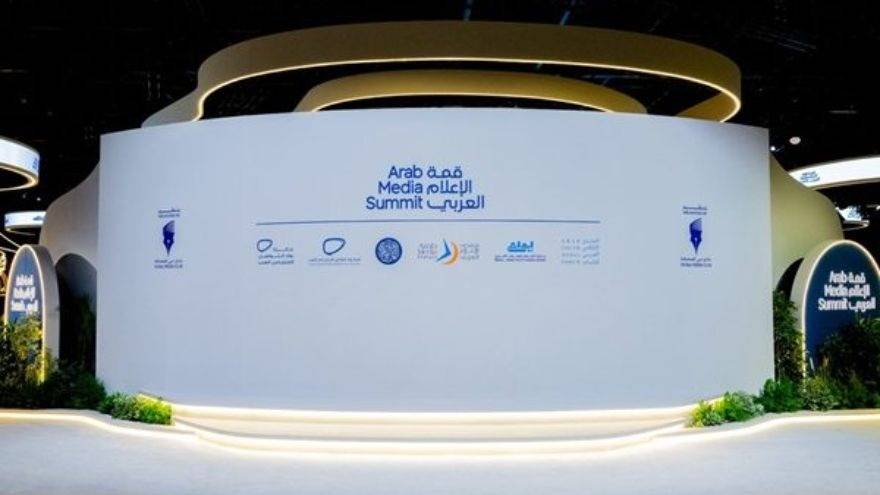
DUBAI – The 24th Arab Media Summit opened in Dubai on Tuesday, bringing together senior political, media, business and creative figures from across the Arab world and beyond.
Syrian President Ahmed Al Sharaa was among the leading figures at the opening, using a keynote dialogue to outline Syria’s economic prospects, the importance of regional stability and the growing role of UAE investors in the country. The three-day summit, being held at Dubai World Trade Centre until September 17, is the largest edition in the event’s history, with more than 175 sessions and over 400 speakers.
Held under the patronage of His Highness Sheikh Mohammed bin Rashid Al Maktoum, Vice President and Prime Minister of the UAE and Ruler of Dubai, and under the directives of Sheikh Ahmed bin Mohammed bin Rashid Al Maktoum, Second Deputy Ruler of Dubai and Chairman of the Dubai Media Council, the summit brings together voices shaping the future of Arab media.
The opening programme features discussions spanning artificial intelligence, digital transformation, emerging technologies, journalism, broadcasting, social media and changing audience behaviour, alongside political and economic issues affecting the region.
Syria’s prospects
Speaking during a keynote dialogue titled Syria of the Future, Al Sharaa highlighted the growing role of UAE investors in Syria and referred to planned projects involving Emirati businessman Mohamed Alabbar. He said the value of the proposed investments had not yet been announced because the plans remained under development.
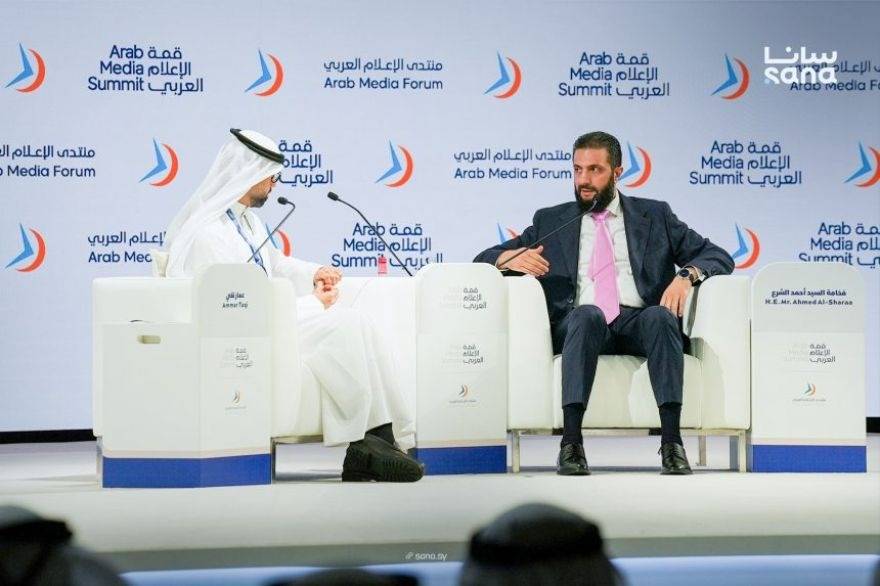
The Syrian President also cited DP World’s investment in the Port of Tartous as an example of the UAE’s ability to identify opportunities in Syria. He said investment in ports and infrastructure could help restore Syria’s position within regional trade and energy supply chains.
Al Sharaa said Syria was moving from being viewed as a source of regional instability towards becoming an economic and strategic opportunity. He described stability as a regional interest rather than an issue affecting Syria alone.
“Syria’s stability today does not serve Syria alone, but the entire region. It is a shared interest for everyone,” he said.
The Syrian President said the country could support commercial corridors connecting markets across West Asia and the wider region. With infrastructure restored, Syria could become a centre for energy supply chains as well as commercial and industrial exchange.
“We can say that Syria could become a major opportunity for the international community,” he said, adding that the opportunity extended beyond economic considerations to politics, security and humanitarian issues.
Al Sharaa described Syria’s transition as a move from “a major arena of conflict to a station for peace”, while stressing that rebuilding the country would require substantial international participation.
“These transformations cannot be undertaken by Syria alone,” he said. “There must be a significant contribution from other countries.”
Tourism potential
Tourism was also highlighted as a potential driver of Syria’s recovery. Al Sharaa noted that before the conflict, Syria formed part of regional travel routes linking visitors from the Gulf with Damascus and other cities across the Levant.
He said restoring the tourism sector could attract Arab and international visitors while generating economic activity in Syria and neighbouring countries.
The rebuilding effort, he said, would extend across infrastructure and productive sectors, requiring investment and cooperation from international partners.
Al Sharaa also identified rebuilding trust between Syrians and state institutions as one of the country’s principal challenges. He said many citizens had for years felt that institutions including the government, parliament and judiciary did not adequately represent them.
Rebuilding those institutions and restoring their relationship with the public would therefore be central to Syria’s transition, he said.
The country was now passing through stages of rebuilding the state and its institutions after years of political conflict and economic damage. During this process, Syria also faced the task of maintaining infrastructure, public services and energy supplies.
Al Sharaa said stronger public administration would require better planning, consistent follow-up and effective use of technology. He also pointed to Syria’s people and its long history of commercial activity as important strengths for the country’s future.
He stressed that the transition should be inclusive, saying no community or individual should be excluded because of religion, ethnicity, belief or school of thought.
“We cannot exclude any group, any person or any belief,” he said.
Global media voices
The wider summit programme features a high-profile line-up of Emirati, Arab and international speakers. Sheikha Latifa bint Mohammed bin Rashid Al Maktoum, Chairperson of Dubai Culture and Arts Authority, is delivering a keynote address.
Among the senior UAE figures taking part are Dr Anwar Mohammed Gargash, Diplomatic Advisor to the UAE President; Abdulla bin Touq Al Marri, Minister of Economy and Tourism; Noura Al Kaabi, Minister of State; Abdulla bin Mohammed bin Butti Al Hamed, Chairman of the National Media Authority; Dr Ali Rashid Al Nuaimi, Chairman of the Defence Affairs, Interior and Foreign Affairs Committee at the Federal National Council; and Dr Mohamed Al Kuwaiti, Head of the UAE Cybersecurity Council.
The international line-up includes Jasem Mohamed Albudaiwi, Secretary General of the Gulf Cooperation Council; Massad Boulos, Senior Advisor to the President of the United States on Arab and Middle Eastern Affairs; Elias Bou Saab, Deputy Speaker of the Parliament of Lebanon; Hikmet Hajiyev, Assistant to the President of Azerbaijan and Head of the Department of Foreign Policy Affairs of the Presidential Administration; and Maka Botchorishvili, Vice Prime Minister and Minister of Foreign Affairs of Georgia.
The summit is also hosting information ministers from Bahrain, Syria, Lebanon, Egypt and Jordan, alongside senior figures from major international media organisations. The line-up includes Paul Bascobert, President of Reuters News; Pedro Vargas David, Chairman of Euronews and CEO of Alpac Capital; Claus Strunz, CEO of Euronews; Phil Chetwynd, Global News Director of Agence France-Presse; and journalist Hala Gorani.
Eight forums
More than 175 sessions across the three-day event are bringing together senior officials, editors-in-chief, writers, strategic analysts, content creators and influencers from 23 countries.
The summit incorporates eight specialised forums: the Arab Media Forum, Government Communication Forum, Arab Youth Media Forum, Films Forum, Games Forum, Dubai PodFest, Arab Social Media Influencers Summit and Euronews Forum.
The Government Communication Forum is being held for the first time as part of the Arab Media Summit, while the programme also features events organised with leading global media organisations, training sessions and workshops.
Three major award ceremonies are scheduled during the event: the Ibda’a Arab Youth Media Award, the Arab Media Award and the Arab Social Media Influencers Award.
The summit’s programme also extends beyond political and media discussions, with prominent Arab actors and Gulf stars taking part in sessions and activities. Participants include Abed Fahed, Ahmed Al Awady, Nadine Nassib Njeim, Nelly Karim, Dina El Sherbiny, Karess Bashar, Carmen Bsaibes, Yara Elsokkary and Youssef Al Khal, alongside Gulf stars Samira Ahmed, Dawood Hussain and Mohammed Al Mansour.
The 24th edition continues at Dubai World Trade Centre through September 17, with discussions examining the rapid transformation of Arab media and the technological, political and economic forces reshaping how audiences consume information.